

Would I recommend it for virtual teams?
I’m on the fence.

I appreciate the approachability of The Table Group content and how it’s narrative can adapt to most any business / role / phase of growth. The only obstacle would just be the cost. These kinds of tools can be really beneficial for teams that have a diverse community or find they are really struggling to understand what motivates each other. However, not all teams have professional development budgets that can cover exercises like these.
I’d recommend it if new teams are having to get to know each other quickly or under duress… (i.e. fast and dirty merger or acquisition with a big launch or deprecation on the horizon). Or, this tool could be helpful if a significant disruption caused a shift in leadership (i.e. previous exec leading the team was removed).
My first experience with the Working Genius team dynamic model was after I returned from parental leave following the birth of my kiddo. While away, my marketing org was shuffled and my supervisor was no longer the VP of Marketing but now directly to the recently-hired CMO. This new exec understood the risks of a shortened ‘honeymoon’ phase and used it as part of a larger team building structure.
I’m happy to share my own results below. You can get a peek at my professional weaknesses and strengths and see if you’d like to take this assessment with your team.
Quick Summary of Working Genius
All work flows through a a series of skills: Wonder, Invention, Discernment, Glavanizing, Enablement, and Tenacity. Of these 6 skills, people have 2 that are their ‘genius’—the skill they are strongest in and find the most fulfillment from. Then two that are their competency—they can operate strongly in this skill but are not necessarily fulfilled by it. Lastly, the final 2 skills may be a weakness, a distraction, or a frustration.
When you have a team that spreads their skills out across the WIDGET, and those members understand each others strengths and weaknesses, then you end up with a very resilient organization.
My Working Genius Results
| Genius | Competency | Frustration |
| Wonder, Enablement | Invention, Galvanizing | Tenacity, Discernment |
| naturally gifted at and derive energy and joy from… – pondering possibilities and opportunities – providing others with encouragement and assistance | Capable of and don’t mind… – creating original and novel solutions – rallying people and inspiring them to take action | aren’t naturally gifted and don’t derive joy from… – pushing projects through to completion – using my intuition and instincts to evaluate ideas |
⭐️ The Idealistic Supporter ⭐️
(your unique pairing of genius items coordinates with an archetype, 6 items = 15 pair options)
The “rough edge” of an idealistic supporter, “WE/EW — The Idealistic Supporter — They can sometimes be overly deferential and often hesitate to initiate change, preferring to let others make the first move.”
A little bit like a horoscope, in my opinion…. there are plenty of times in my career I think I’ve been deferential. However, it’s because the chess game I’m playing in my head is 5 moves ahead and sees the energy exerted now won’t pay off. I need to play a few more moves before pushing an agenda to get what I want. To some I may appear deferential, but knowing when and where to push is how to navigate peer and cross-functional management. In many of my roles, I’m not a top-down leader but rather a behind-the-scenes catalyst to inspire the result I want.
So my ‘rough edge’ is all perspective, and I’m guessing the folks who wrote these archetypes weren’t WE/EWs.
It has been helpful for how to put my professional weaknesses into words though.
- Being dismissed – I can become very insistent and aggressively determined or rebellious if my input is dismissed as a time waste, unimportant without being given the space to argue my point.
- Being overlooked – if my efforts are not recognized/acknowledged—and before you accuse me of being an attention-seeker (I totally am) it’s not about getting a gold star, but rather when someone assumes that my work didn’t take effort (because I made it look effortless).
Want to see the full Working Genius profile for June Laves?
Applying the Working Genius to Your Team
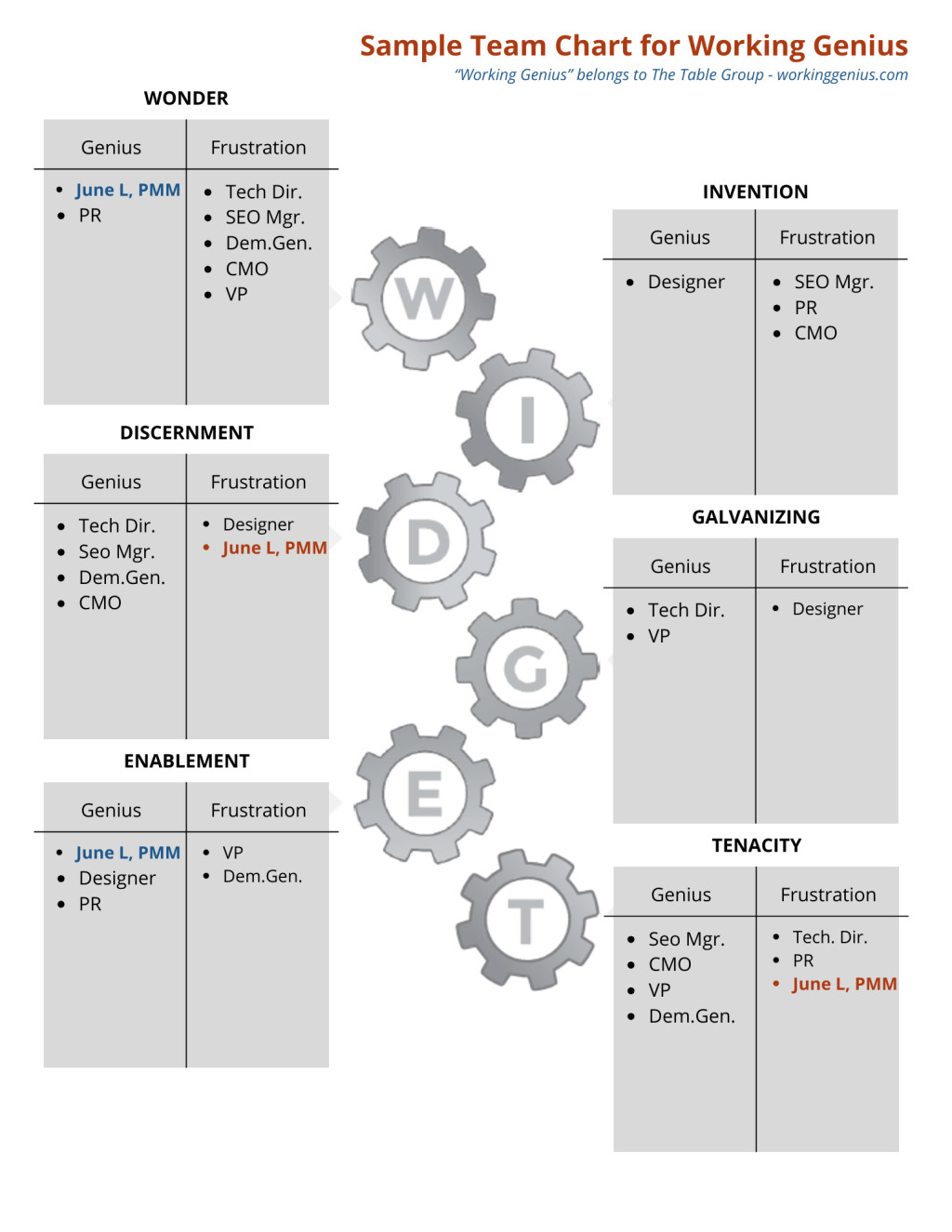
Here’s a sample team chart that The Working Genius gives your team once everyone completes the assessment. I’ve obviously removed the names of my teammates and used a generic title similar to their roles and flip-flopped some of their data just to protect them. The gist is the same though.
This team map does make it easy to see potential “gaps” in the teams skills. At the same time, it makes it easy to suggest who would be great for leading a potential project based on skills. Inventing a new solution? We should probably make sure that the Designer is leading and consulted. Need to enable multiple teams toward a single goal? Probably worth adding me to that task. 😉

 June Laves - Empathy-driven PMM
Leave a comment